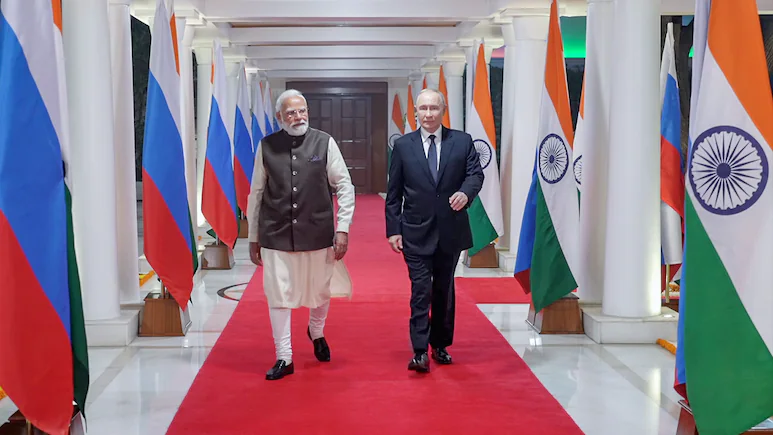
Vladimir Putin’s visit to New Delhi highlighted something the world often forgets: India’s relationship with Russia is older, deeper and more structurally rooted than contemporary commentary allows. It has endured for decades.
These ties have shown a consistency rare in international affairs. Over the past twenty-five years, India has widened its diplomatic horizon, expanded engagement with the West and corrected Soviet-era imbalances. But this did not involve abandoning Russia. It involved recalibrating the partnership on more realistic terms.
For all the turbulence in global politics, the Russia relationship remains relevant. It is one of India’s most resilient and time-tested partnerships. That matters at a moment when many great-power equations are unsettled. The summit reflected India’s enduring strategic logic: diversify partners, balance relationships and maintain working ties with all major power centres, especially those shaping Eurasian security and energy flows.
Russia remains a nuclear power, a major energy exporter and a permanent member of the UN Security Council. It wields influence in Central Asia, the Middle East and parts of the Global South. Despite the fallout of the invasion of Ukraine, Russia has not become irrelevant. India cannot decouple from a country whose decisions affect its security, its energy pricing and the strategic landscape on its northern frontier.
About the Author