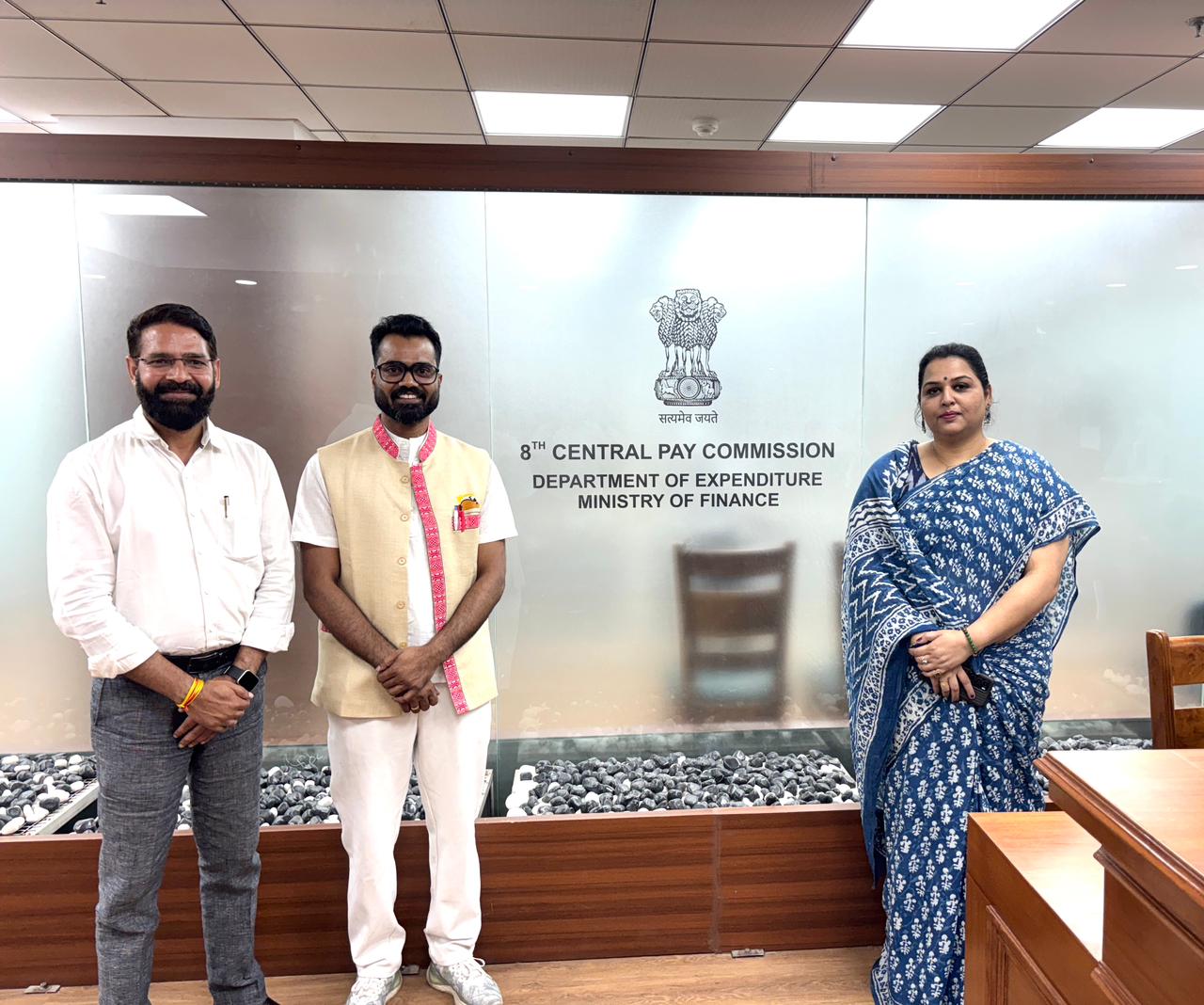
New Delhi: The All India NPS Employees Federation (AINPSEF), under the leadership of National President Dr. Manjeet Singh Patel, made a strong and impactful representation during the discussions on key aspects of the 8th Central Pay Commission (#8CPC).
Representing the federation, Shri Vinod Kumar Yadav, Chairman of the National Co-ordination Committee & President (Delhi), along with Ms. Chayanika R. Chauhan from AIIMS, presented critical issues concerning employees with clarity and conviction.
The meeting was conducted in the presence of Hon’ble Chairperson Justice Ranjana Prakash Desai, along with Hon’ble Members Shri Pulak Ghosh and Shri Pankaj Jain, and attended by senior officials including Directors and Deputy Secretaries. All submissions were heard with due seriousness, leading to constructive discussions on multiple aspects.
AINPSEF expressed its full support for the major demands raised by the JCM (Staff Side), including implementation of a 3.83 fitment factor, revised HRA rates (15%, 30%, 45%), merger of Dearness Allowance with Basic Pay at 25%, rational increase in Transport Allowance, revision of Children Education Allowance, introduction of Digital Allowance, and expansion of the family unit definition from three to five members.
A major highlight of the Federation’s intervention was its firm stand on pension security. It emphasized that the existing National Pension System (NPS) and Unified Pension System (UPS) fail to ensure guaranteed social and income security post-retirement. The Federation demanded discontinuation of these systems and called for the implementation of a secure, guaranteed pension framework. It further proposed extending Old Pension Scheme (OPS) benefits—currently applicable in death and disability cases—to all forms of retirement, including superannuation, voluntary retirement, and compulsory retirement.
The Federation also proposed the concept of “One Nation – One Service Mobility,” advocating uniform service conditions across Central Government, State Governments, Union Territories, and autonomous bodies. This includes equal implementation of service benefits and uniform HRA structures to ensure administrative consistency and better employee mobility.
Addressing the concerns of the education sector, AINPSEF highlighted anomalies faced by teachers and demanded parity with UGC faculty and medical professionals, including enhancement of retirement age up to 65 years and overall service upgradation.
In addition, comprehensive leave reforms were proposed, including 14 Casual Leaves, 30 Earned Leaves, 20 Medical Leaves, and advance credit provisions of 45 days each for Social Obligation Leave and Family Care Leave.
Concluding its submission, AINPSEF emphasized that ensuring social security, uniform service conditions, and dignified working environments is essential for building a strong, efficient, and humane administrative system.
About the Author