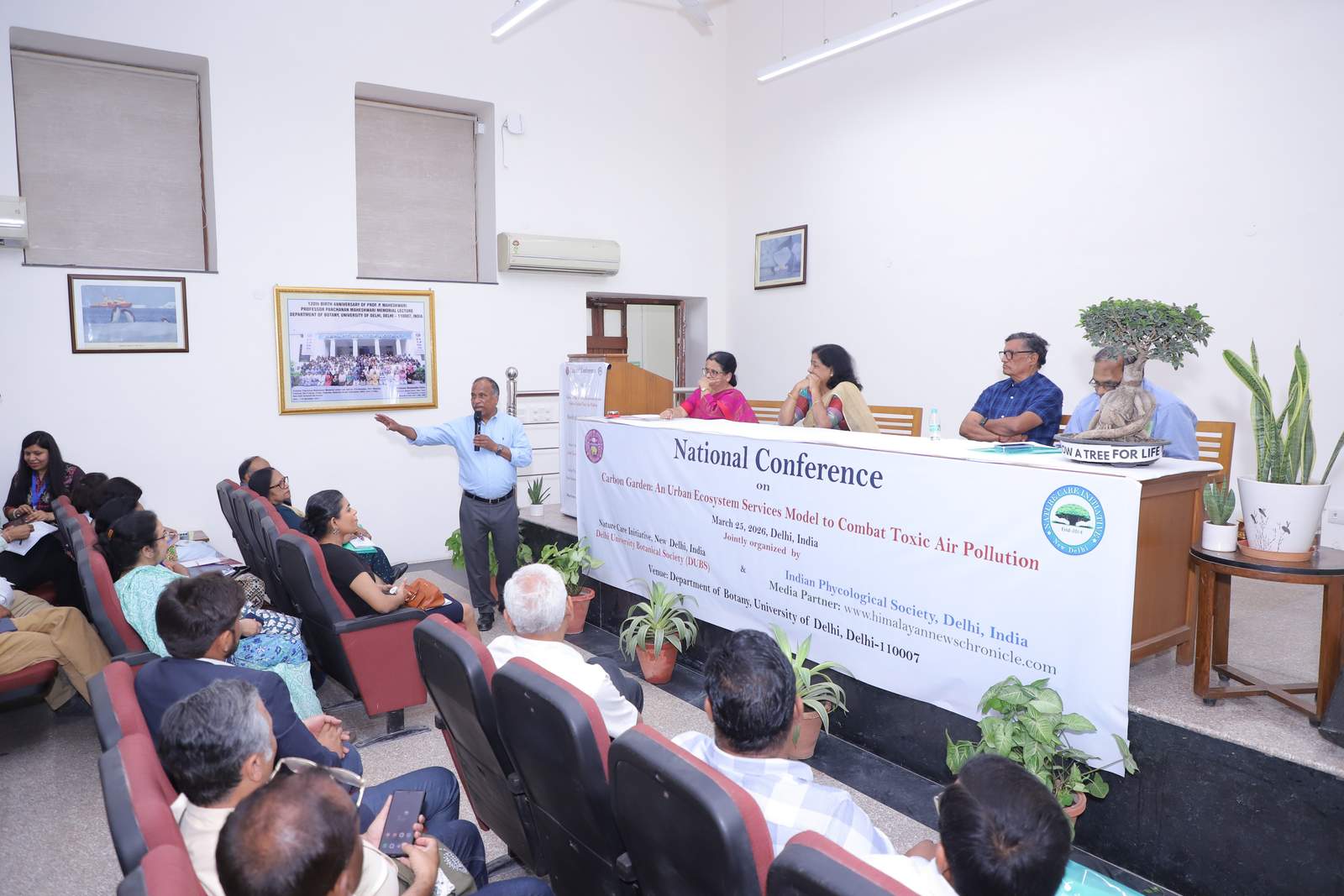
New Delhi, March 26: Experts from different fields today agreed
that instead of having a fire brigade approach to tackle the worst
ever air pollution in urban centres like Delhi, the novel concept
of “Carbon Garden” of the Delhi University’s self-sustaining
ecological defences should be an ideal solution.
The University’s Carbon Garden represents a quiet shift in how
cities might confront environmental stress, the experts from
different fields said in a day long “National Conference on Carbon
Garden: An urban ecosystem service model to combat Toxic Air” in
the campus. Instead of treating pollution only after it spreads,
this approach builds self-sustaining ecological defences directly
into urban spaces, they said.
Prof Dinabandhu Sahoo, Head of the Botany Department of the varsity
had launched India’s first Carbon Garden this year in a 2,000-
square-foot facility designed to combat air pollution by
sequestering and reducing toxic gases. This “living lung” uses
native plants and microorganisms on tree bark to improve air/soil
quality.
The carbon garden is not merely ornamental, but a functional
ecosystem featuring a curated mix of native plants, including
hydrophytes, xerophytes, and mesophytes. The garden focuses on
removing harmful greenhouse gases like carbon dioxide and methane,
along with carbon monoxide from the atmosphere.
Inaugurating the conference, Dr Sahoo said if small carbon gardens
are created in every school, colleges, universities, residential
and Office complex, it will significantly improve air and soil
quality as well as mental health. It can give freedom from toxic
air, enhance the quality of Life, and reduce our medical express
said Sahoo, he said.
Ms Shweta Thakur Nanda, of Morning Sprout Consulting Ltd in her
speech said that rising air pollution is one of the most important
threats to human health in recent years. Quoting the World Health
Organisation (WHO) she said every year more than 70 lakhs people
die due to air pollution across the world including 17 lakhs in
India.
Based on the World Air Quality report by IQAir 2025, 13 of the
world’s top 20 polluted cities are from India and air pollution is
responsible for nearly 15 percent of all deaths in Delhi alone.
Further, it was estimated that death attributable to air pollution
accounted for economic losses of $36·8 billion in India every year.
Experts from different parts of the country gathered and discussed
the establishment of carbon gardens across the big cities as one of
the nature-based solutions for combating air pollution during the
conference. Other experts included Akhilesh Prasad Singh, Vice
President, Nature Care Initiative, Prof. Chirashree Ghose,
Department of Environmental Studies, DU, Dr. R. B. Srivastava,
Former Director, DIHAR, DRDO, Leh, Dr. Nabajyoti Deka, of DU.
The conference was organised by Nature Care Initiative, Delhi
University Botanical Society (DUBS), Indian Phycological Society
and Himalayan News Chronicle, a magazine focusing on the
environment.
About the Author